
Healthcare Resources
As this current presidential administration continues to attack the healthcare in our most vulnerable communities, we must come together to look out for our neighbors and ensure that our health always remains a priority. Our team has developed resource for LGBTQ+ folks and those in need of reproductive care, and the threat to our overall healthcare deserves a highlight as well.
This page was created to provide information regarding public health and disability rights laws and resources for our constituents and any other individual who may receive healthcare in Illinois. In response to the continued war on public health information, and the spreading of misinformation about disabilities, life-saving medicine, and other health resources, we wanted to provide a space to communicate changes and updates on healthcare programs federally, in Illinois, and in the Chicagoland area. We will continue to keep this page updated as new resources and information become available. If you have any information or resources you would like to share with us and your neighbors, please email us at info@repcassidy.com.
Just Security created a Litigation Tracker, where you can track legal challenges against the Trump Administration.
As legislative and judicial changes and challenges concerning the actions of the Trump Administration on public health and information continue to amount, it is important to stay up to date on the status of bills, laws, and court decisions that may have direct impacts on your health or the health of your loved ones and neighbors.
Legislative Updates Under the Trump Administration
Update Regarding Affordable Healthcare Under "Big Beautiful Bill" Act (H.R. 1) and Trump Administration
On July 4, 2025, President Trump signed the One, Big, Beautiful Bill Act (OBBBA) or H.R. 1 into law. This bill cuts over 1 trillion dollars in health programs, making it the largest rollback in medical support in American history. The bill accelerates the timeline in which the Medicare trust fund will become bankrupt, and cuts nearly $500 billion in funding from Medicaid between 2026 and 2034.
In addition to cuts in Medicaid funding, H.R. 1 also affects:
-
Work requirements: Able-Bodied Adults Without Dependents (ABAWD) will need to meet new work or training requirements to keep their Medicaid coverage.
-
More frequent eligibility checks: States will need to verify eligibility for Medicaid more often, which historically leads to coverage losses even among those who remain eligible.
-
Immigration restrictions: Certain groups of lawfully present immigrants will lose Medicaid eligibility.
-
Reduced state funding options: The law restricts the use of “provider taxes” by states to generate additional money for their Medicaid programs.
Before H.R. 1, lawfully present non-citizens could qualify for Medicare by meeting work history requirements or, if they lacked the required work credits, by meeting length of residency requirements. Now, only the following groups can newly enroll in Medicare:
-
U.S. citizens,
-
Lawful permanent residents (green card holders),
-
individuals from certain Pacific Island nations with special agreements with the U.S. (“COFA” migrants).
This eliminates Medicare eligibility for all other lawfully present immigrants, regardless of how long they have worked and paid into the system, including:
-
Refugees and people granted asylum,
-
People with Temporary Protected Status,
-
Survivors of human trafficking,
-
Survivors of domestic violence, and,
-
Individuals granted humanitarian parole.
Under H.R. 1, over 10 million Americans will likely lose Medicaid coverage.
Status of the Affordable Care Act (ACA/Obamacare) under the Trump Administration
The Affordable Care Act (ACA, also known as Obamacare) strengthened Medicare, expanded Medicaid, and provided greater access to healthcare coverage for millions of Americans. The ACA eliminated annual and lifetime limits on care and ensures people with pre-existing conditions are not denied coverage.
The Trump Administration has taken several measures to limit ACA provisions in an attempt to eliminate the act altogether. H.R. 1 established federal work reporting requirements for people enrolled in Medicaid that will go into effect at the end of 2026. Most people with Medicaid already work or qualify for an exemption to this rule, but the requirement to prove work status may cause backlog and unclear information sharing that will lead to a loss of coverage. This rule would set up new barriers to enrollment in the marketplace setting and allow coverage denials for people who owe premiums or seek gender-affirming care.
Click here for access to the Illinois healthcare marketplace to learn more about how to stay on top of your healthcare coverage.
Recent Court Cases, Rulings, and Updates on the Trump Administration's Attacks on Healthcare
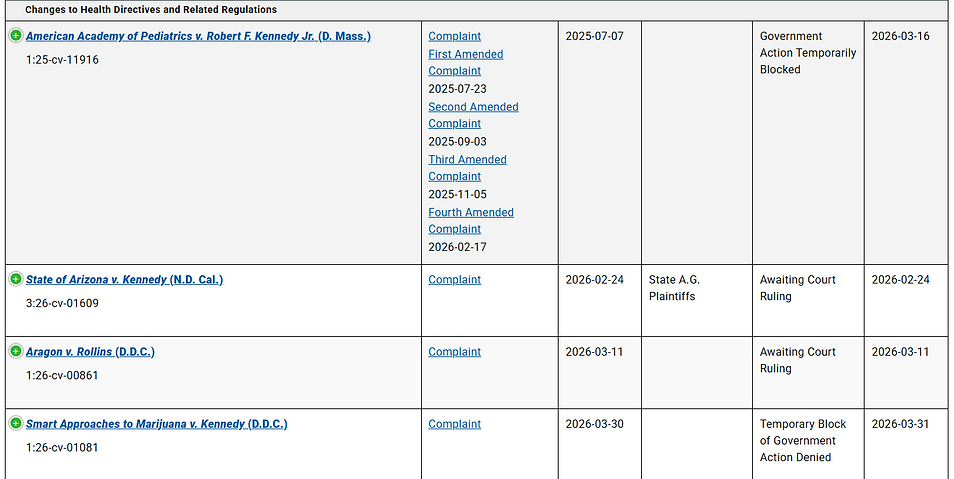
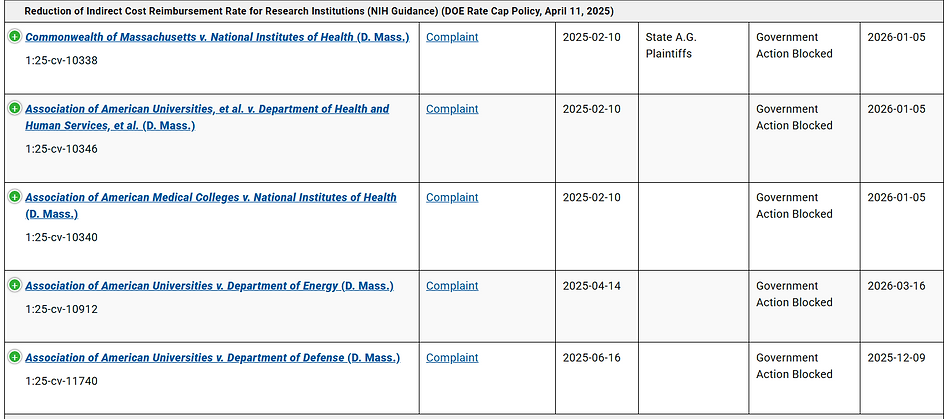
All updates taken from Just Security's Litigation Tracker
Some key words to know when reading the Litigation Tracker charts:
Date in Third Column: Date the case was filed
Date in Last Column: Date the case was last updated
Complaint: Legal pleading and information that starts a court case
Government Action Blocked: The action taken by the federal government was blocked by a federal judge
Government Action Denied: The action taken by the federal government was not blocked by a federal judge and the complaint was denied


Illinois State Healthcare and Public Health Legislative Updates
The Illinois Department of Public Health releases a yearly update with laws going into effect at the state level that will directly impact the public health of the people of Illinois. Their 2026 list includes laws taking effect from January all the way to September ranging from a wide variety of topics including infectious disease control, mental health services, and access to reproductive care.
Representative Cassidy takes great pride in being a champion of increased healthcare access. She is the chief co-sponsor of many bills related to public health and healthcare initiatives in the 104th General Assembly, including:
HB2589: This bill makes clear that when someone has a prescription for an injectable medication, pharmacists must allow the patient to purchase the needles required to access their medication. This bill has been signed into law.
HB4834: This bill will purge records of testosterone prescriptions from the Prescription Monitoring Program and will prohibit inclusion of medications used in abortion or gender affirming care if the federal government adds them to the list of scheduled drugs. This bill passed both chambers and heads to the governor’s desk.
SB3213: This bill is the companion bill to HB5046 that intends to address at least some of the challenges faced by chronic pain patients and others who depend on medications that face shortages by easing the process for transferring prescriptions between pharmacies and making it easier to determine whether a particular drug is in stock. This bill passed by a vote of 57-0 in the Senate and now makes its way through the House.
HB3711:This bill creates procedures and accountability measures for medical professionals and facilities that abuse patients. This bill is pending in the Senate from the 2025 session and is still being negotiated.
Missing or Altered Information on Federal Government Websites and Databases
Since the beginning of the second Trump Administration in January of 2025, there has been a marked increase in reported instances of federal health websites and resources disappearing without notice, and then reappearing at a later time with altered or missing information. Medical organizations, researchers, physicians, nurses, and other public-health advocates have warned that these actions reduce transparency and increase the spread of misinformation concerning public health initiatives.
Federal agencies, particularly the CDC and FDA, have had multiple reported instances of removing or blocking access to information including:
-
LGBTQ+ health resources
-
Minority-health data
-
Reproductive health resources
-
Infectious disease tracking datasets
-
Vaccine safety research
In some cases, webpages have disappeared entirely. In others, they have been restored with altered language or missing figures.
Reporting conducted by NPR in the first few months of the second Trump Administration in 2025 focused on the CDC’s removal and alteration of several public-health datasets and webpages focused on LGBTQ+ health, reproductive health resources, and the Youth Risk Behavior Surveillance System datasets. Healthcare professionals repeatedly reported archival links no longer working, disappearing datasets, and pages restored with altered language and missing information.
A lawsuit brought against the Trump Administration in May of 2025 by nine Washington-based public health organizations, including the Washington State Nurses Association cites the removal of public health resources from federal government webpages as being detrimental for healthcare services and research. These organizations argue that clinicians rely on government information for patient care, researchers use datasets for analysis, and the people have a right to view information from taxpayer-funded databases, resulting in politically motivated and unlawful removals and alterations. A settlement was reached in September of 2025, when a federal judge ordered the U.S. Department of Health and Human Services to restore over 100 websites and resources on a range of topics including pregnancy risks, opioid-use disorder, and the AIDS epidemic, to the state they were in before they were altered or taken down. The war on public health misinformation continues, and we will keep winning the fight.
In early 2026, the New York Times reported that federal officials blocked the publication of several vaccine studies conducted by the FDA, specifically concerning the COVID-19 vaccine and the Shingles vaccine Shingrix. Research from these studies concluded that the vaccines were generally safe for public use and serious adverse effects were rare.
Trans Suicide Hotline by Trans Lifeline
877 565 8860

Trans Lifeline’s Hotline is a peer support phone service run by trans people for our trans and questioning peers. Please call if you need someone trans to talk to, even if you’re not in a crisis or if you’re not sure you’re trans.
Rep. Cassidy’s Remarks on Anti-Trans Executive Orders from the House Floor
(January 28, 2025)

Illinois Attorney General Kwame Raoul Reaffirms Commitment to Protecting Access to Gender-Affirming Care
On February 5, 2025, Illinois Attorney General Kwame Raoul released a statement that he had joined a coalition of 14 attorneys general in reaffirming their commitment to protecting access to gender-affirming care. This comes in response to the President’s recent string of executive orders attacking trans rights, particularly targeting access to gender-affirming care for trans youth.

House Dobbs Working Group Members Stand with Attorney General’s Commitment to the LGBTQ+ Community and Gender Affirming Care
The Illinois House Dobbs Working Group, which Representative Cassidy chairs, released a statement in support of Attorney General Raoul and his commitment to fighting for the LGBTQ+ community and gender-affirming care.

"Getting Prepared" List from Equality Illinois
Equality Illinois has provided a list of things people in the LGBTQ+ community should consider getting prepared going into the current administration. Please note that this is not legal advice. For more information regarding your own given circumstance, you should consult an attorney. We will have more attorney resources listed below.
Items to Consider Getting Prepared
-
Update legal documents
-
Verify that children’s birth certificates are up to date with both parents’ names
-
Finalize marriages
-
Assign Powers of Attorney (prepare and finalize health care in particular for spouses and kids)
-
Update wills and trusts
-
Complete name changes
-
Update identification documents
-
Ensure financial and other documents are in order, named beneficiaries, and reflect your legal name and gender
-
Consult your medical provider
-
Updated your prescriptions
-
Ask your medical provider about a plan if there are restrictions in obtaining your meds in the new administration
-
Review authorizations and permissions
-
-
Review data privacy and security settings in your social media apps
-
Review this especially in your Healthcare apps (period tracker apps as well)
-
-
Create a folder that includes copies of these basic documents that is easily accessible and that trusted people can access
Advocates For Trans Equality Webinar:
Trans Rights vs. Trump: How A4TE is Fighting Back
Advocates for Trans Equality’s Trans Legal Survival Guide

As Trans people face more political and legal attacks, Advocates for Trans Equality has created a guide with a list of steps to reduce vulnerability for trans people. Click on the image above to open a PDF link to this guide.
Some Helpful Information from the Human Rights Campaign

Facing the Future Together: FAQs, Guidance, and Resources

Supporting Transgender, Non-binary, and Gender-Expansive Children
Resources and Attorneys
-
Advocates for Trans Equality can assist in connecting you with a network of attorneys who assist with providing name and gender change services and more.
-
Brave Space Alliance is an LGBTQ+ focused space that offers many services including free and onsite HIV testing, medical referrals for a variety of care (including counseling, HIV prevention and treatment, and reproductive health) behavioral health, housing services, workforce development, financial literacy workshops, a food pantry and more.
-
Center on Halsted offers a variety of services focused on advancing the LGBTQ+ community including behavior health, HIV/STI testing and prevention services, youth programming, education and employment programming, and more.
-
The Lesbian and Gay Bar Association of Chicago is one of the largest and most well-respected LGBTQ+ bar organizations in the country. Its members include lawyers, judges, elected officials, law students, and other legal professionals. LAGBAC's website offers several ways to search for an attorney through a searchable directory of attorneys in their organization.
-
You can file a claim with the Illinois Department of Human Rights if you have been mistreated. You can find more information at their website here.
-
The Trevor Project's mission is to end suicide among LGBTQ+ Youth. If you or someone you know is struggling with mental health, they are a great resource.
-
The Illinois Human Rights Commission website where you can find information on the Illinois Human Rights Act.
-
The Ally Education Collective’s LGBTQ+ Ally Education page is a helpful resource for allies of trans folks to learn more about gender-affirming care and the experiences of trans folks from a mother of a transgender child.
-
For more resources, you can also check out our Constituent Service Guide.
Medical Resources for Families With Trans Youth
With the ever changing climate around healthcare for Trans youth we have collected a few resources that may be useful in finding care for your Trans loved on in your area.
-
The LGBTQ+ Healthcare Directory: It is a free, searchable database of all kinds of doctors, medical professionals and healthcare providers who are knowledgeable and sensitive to the unique health needs of LGBTQ+ people in the USA and Canada.
Equality Illinois LGBTQ+ Resource Guide
Equality Illinois has compiled a list of resources for LGBTQ+ people of legal services, youth services, health resources, and crisis hotlines all throughout the state of Illinois. For more information as well as to access a printable copy of this list click the picture below.
